12-Week Concussion Program
Glossary & Exercise Instructions
GLOSSARY OF TERMS
Medical Terms
• Accommodation – The eye’s ability to change focus from distant to near objects
• Balance Error Scoring System (BESS) – Standardized balance test using different stances and surfaces
• Cognitive Load – Mental effort used in working memory
• Concussion – Mild traumatic brain injury caused by a bump, blow, or jolt
• Convergence – Eyes moving inward to focus on near objects
• Diplopia – Double vision
• Dizziness Handicap Inventory (DHI) – Measures perceived dizziness handicap
• Exertional Intolerance – Symptoms worsen with physical or cognitive activity
• Glasgow Coma Scale (GCS) – Assesses level of consciousness
• Nystagmus – Involuntary rhythmic eye movements
• Oculomotor – Related to eye movements
• Photophobia – Light sensitivity
• Phonophobia – Sound sensitivity
• Post-Concussion Syndrome – Symptoms persisting beyond 3 months
• Post-Traumatic Amnesia – Memory loss after head injury
• Proprioception – Sensing body position in space
• Saccades – Quick, simultaneous eye movements
• Symptom Provocation – Temporary increase in symptoms during tasks
• Vestibular System – Inner ear balance system
• Visual Motion Sensitivity – Symptoms triggered by visual movement
Exercise Terms
• Baseline – Starting measurement
• Graded Exercise – Gradual increase in intensity
• Habituation – Less response to repeated stimulation
• Progressive Loading – Increasing difficulty or intensity
• Range of Motion (ROM) – Movement available at a joint
• Repetition Maximum (RM) – Max weight lifted for specific reps
• Sub-Symptom Threshold – Exercise intensity that does not worsen symptoms
• Target Heart Rate – Desired heart rate during aerobic training
SAFETY GUIDELINES
STOP exercising if:
• Symptoms worsen significantly
• New symptoms appear
• Severe headache develops
• Nausea or vomiting
• Severe dizziness
• Changes in vision
Exercise principles:
• Start slow
• Gradually progress
• Stay below symptom threshold
• Rest when needed
• Monitor symptoms before/during/after
• Record daily symptoms
VESTIBULAR & BALANCE EXERCISES
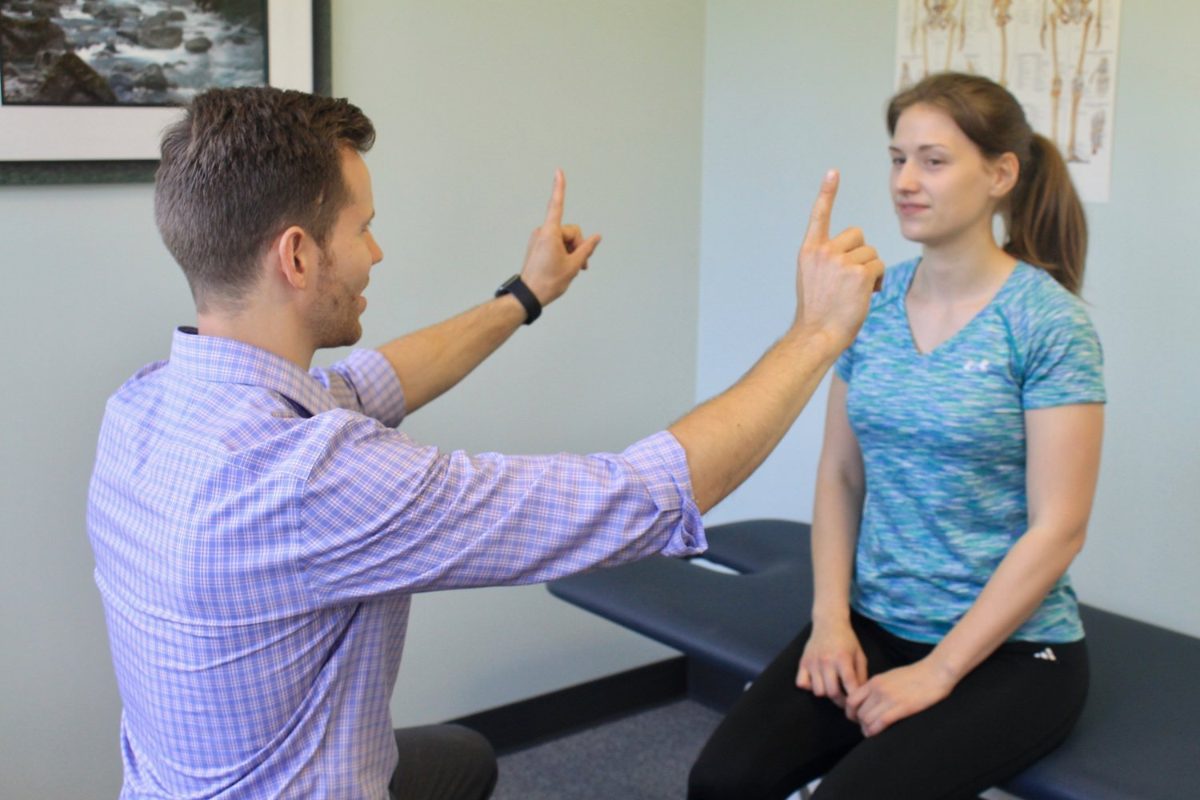
Gaze Stabilization – X1 Viewing (Smooth Pursuit)
Hold thumb 12–18 inches away
Move it left–right (2 seconds each way)
Keep eyes locked on thumbnail
Perform 1–2 minutes
Progress: Increase speed
X2 Viewing (VOR Training)
Hold target 12–18 inches away
Turn head side to side while focusing
Target must stay clear
Start slow
1–2 minutes
Progress: Increase speed
Horizontal Gaze Stabilization
• Look at wall target
• Turn head left–right
• Keep image clear
• 20–30 reps
Vertical Gaze Stabilization
• Look at wall target
• Move head up–down
• 20–30 reps
Static Balance
Single Leg Stance
• Stand on one leg, eyes open
• Hold 30 seconds
• Repeat other side
• Progress: Eyes closed, foam pad, head movement
Tandem Stance
• One foot directly in front of the other
• Hold 30 seconds
• Switch sides
• Progress: Eyes closed, head turns
Romberg Position
• Feet together, arms by sides
• Hold 30 seconds (eyes open)
• Repeat with eyes closed
• Progress: Foam surface
Dynamic Balance
Tandem Walking
• Walk heel-to-toe
• 10–20 steps
• Progress: Eyes closed, foam
Single Leg Balance Reaches
• Stand on one leg
• Reach forward, sideways, backward
• 10 reps each direction
• Progress: Increase reach distance, unstable surface
Heel-to-Toe Walking
• Heel touches toe each step
• 10–15 steps
• Progress: Backwards, eyes closed
Habituation Exercises
Head Movements
• Up–down 20 times
• Rest 30 sec
• Side–side 20 times
• Rest 30 sec
• Slight dizziness is normal
Position Changes
• Sit-to-stand × 10
• Rest 1 minute
• Lie to sit × 10
• Rest 1 minute
• Head-hanging × 5 (if tolerated)
OCULOMOTOR EXERCISES
Saccades
Horizontal
• Two targets 2–3 feet apart
• Look quickly between them
• 20 reps
• Progress: Increase distance
Vertical
• Targets above and below
• 20 reps
Diagonal
• Targets in 4 corners
• 10 cycles
• Progress: Increase speed
Convergence
Near-Far Focus
• Pencil 6 inches from nose → 5 seconds
• Look at distant target → 5 seconds
• 2–3 minutes
• Progress: Bring pencil closer
Pencil Push-Ups
• Bring pencil toward nose
• Stop at double vision
• Repeat 10–15
Pursuit Tracking
• Move target in figure-8
• 1–2 minutes
• Progress: Increase speed or size
COGNITIVE EXERCISES
Attention
Sustained Attention
• Count backwards from 100 by 7s
• 2–3 minutes
Divided Attention
• Balance while reciting alphabet
• Walk while naming animals
• One-foot stance with mental math
Memory
Working Memory
• Repeat numbers backward
• Start 3 digits → progress to 6–7
N-Back
• Start with 1-back → progress to 2 or 3
• 15–20 min daily
Processing Speed – Stroop Task
• Say color of ink, not word
• Progress by adding more items
AEROBIC CONDITIONING
Heart Rate Zones
• Recovery: 50–60%
• Aerobic Base: 60–70%
• Aerobic: 70–80%
Max Heart Rate
• 220 − age
• OR use RPE 1–10
Stationary Bike
Week 1–2
• Warm-up 5 min
• 10–15 min at 60–65%
• Cool-down 5 min
• Progress: +2–3 min weekly
Week 3–4
• Warm-up 5 min
• 15–20 min at 65–70%
• +5 min intervals at 75%
Treadmill
Walking
• 10–15 minutes
• Add 2–3 minutes weekly
• Goal: 30+ minutes
• Progress: Add incline/speed
Running
• Week 1–2: Walk/jog 1:2
• Week 3–4: Walk/jog 1:1
• Week 5–6: Easy jog
• Week 7+: Sport-specific
NECK STRENGTHENING
Isometrics
Neck Flexion – hand on forehead
Neck Extension – hand behind head
Lateral Flexion – hand on side of head
• Hold 5–10 sec
• Repeat 10 each
Range of Motion
Neck Rotations – 10 each side
Neck Flexion/Extension – 10 each direction
RETURN-TO-PLAY PROGRESSION
Stage 1: Rest
• Only daily activities
• Goal: Reduce symptoms
Stage 2: Light Aerobic
• Walking/bike
• <70% HR
• 15–20 minutes
Stage 3: Sport-Specific
• Running, drills
• Moderate intensity
Stage 4: Non-Contact Training
• Full training, no contact
Stage 5: Contact Practice
• Full participation
Stage 6: Competition
• Requires medical clearance
EXERCISE PRESCRIPTION EXAMPLES
Week 1–2: Initial Phase (20–30 min/day)
• X1 viewing – 2 min
• Single leg stance – 30 sec
• Serial 7s – 2 min
• Walking – 10–15 min
• Neck ROM
Week 3–4: Early Active (30–40 min)
• X2 viewing – 2 min
• Tandem walking – 20 steps
• Pencil pushups – 15 reps
• Stationary bike – 15–20 min
• Neck isometrics
Week 5–6: Intermediate (40–50 min)
• Habituation – 10 min
• Balance reaches – 10 each
• Saccades – 5 min
• Jog intervals – 20–25 min
• Sport-specific work
Week 7+: Advanced Phase
• Sport-specific program
TROUBLESHOOTING
“Exercise makes me dizzy”
• Reduce intensity
• Take breaks
• Hydrate
• Slow progression
“I can’t balance with eyes closed”
• Start eyes open
• Use wall support
• Progress gradually
“Visual exercises cause headaches”
• Shorter sessions
• More breaks
• Correct lighting
• Check vision
Modify program if:
• Symptoms worsen >24 hours
• New symptoms appear
• No progress after 2 weeks
• Compliance drops