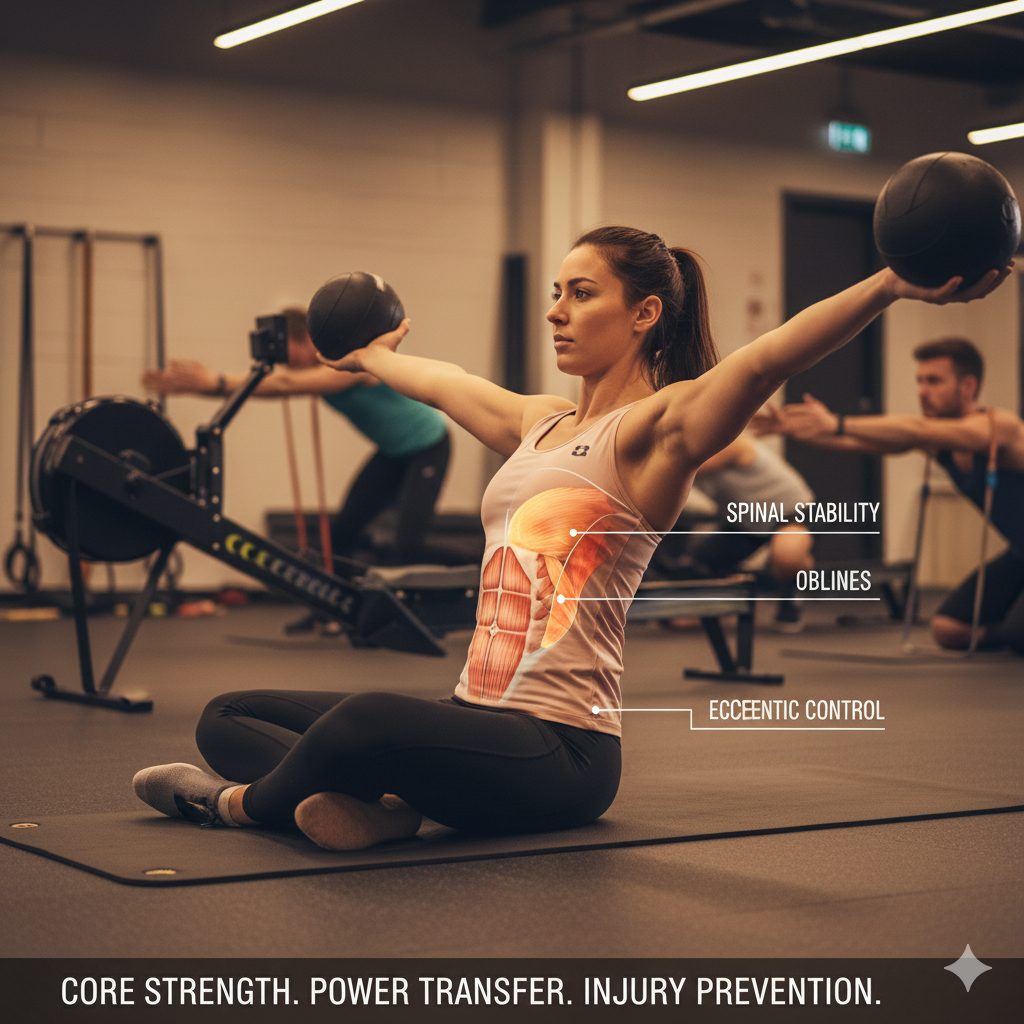
Core training is fundamental to rowing performance, but not all core exercises are equally effective. Research shows the core's primary function in rowing is to create a stable, rigid lever that transfers force between the hips and shoulders during the stroke. This guide provides evidence-based methods to improve performance and reduce injury risk.
Understanding the Rowing Core
The rowing core includes multiple muscle groups:
Rectus Abdominis: Resists spinal extension
External & Internal Obliques: Control rotation and lateral flexion
Transverse Abdominis: Deep stabilizer acting as a natural weightlifting belt
Erector Spinae: Stabilizes and extends the spine
Multifidus: Deep spinal stabilizers
Glutes & Hip Flexors: Essential for power transfer
How the Core Functions During the Rowing Stroke
Early Drive Phase
High activation in posterior trunk muscles (spinal erectors, glutes, hamstrings)
Spine acts as a rigid lever for power transfer
Late Drive Phase
Increased anterior abdominal activity
Core controls the swing into the finish via eccentric contraction
Recovery Phase
Core stabilizes the torso
Prevents excessive spinal flexion or extension
Benefits of Proper Core Training
Power Transfer: Efficient force transmission
Injury Prevention: Reduced lumbar stress
Technique Stability: Better posture and form
Endurance: Improved core stamina during long races
Balance: Increased boat stability
Three Essential Categories of Core Training
1. Anti-Extension Exercises
Planks (30–60 sec)
Dead Bugs (8–12 reps per side)
Hollow Holds (15–30 sec)
Ab Wheel Rollouts
TRX/Ring Planks
Overhead Pallof Press (10–12 reps)
2. Anti-Rotation Exercises
Pallof Press (10–12 reps per side)
Bird Dogs (8–10 reps per side)
Renegade Rows (8–10 reps per side)
Side Planks (30–60 sec)
Copenhagen Planks (20–30 sec)
Half-Kneeling Cable Chops (10–12 reps)
Single-Arm Carries (30–40 yards)
3. Hip Hinge & Posterior Chain Exercises
Deadlifts (5–8 reps)
Kettlebell Swings (15–20 reps)
Hip Thrusts (10–15 reps)
Single-Leg RDLs (8–10 reps per leg)
Glute Bridges (15–20 reps)
Good Mornings (8–12 reps)
Rowing-Specific Core Exercises
Seated Rockback
Highly recommended for rowers.
How to perform:
Sit with knees bent, arms extended
Rock back with a neutral spine
Control eccentric motion
Perform 8–10 reps → progress to 12–15
TRX/Ring Suspension Core Work
TRX/Ring Planks
TRX/Ring Rows
TRX/Ring Pike
TRX/Ring Mountain Climbers
TRX/Ring Fallouts
Exercises to Avoid
Sit-ups & Crunches (excessive spinal flexion)
Russian Twists (loaded rotation stress)
Excessive long planks (>60 sec)
Any exercise done with poor form
Core Training Programming Guidelines
Frequency: 2–3 sessions per week
Reps: 8–15 for strength movements
Isometrics: 15–30 sec holds
Sets: 2–3
Session Duration: 10–20 minutes
Include 1–2 core warm-up exercises before rowing
Progressive Overload
Progress by:
Increasing weight/resistance
Adding reps or hold time
Using unstable surfaces
Moving from bilateral → unilateral
Increasing ROM
Reducing rest time
Sample Weekly Core Program
Monday — Anti-Extension + Hip Hinge
Dead Bugs: 3×10/side
Hollow Holds: 3×20–30 sec
Deadlifts: 3×6–8
Glute Bridges: 2×15
Wednesday — Anti-Rotation + Rowing-Specific
Pallof Press: 3×12/side
Bird Dogs: 3×10/side
Seated Rockbacks: 3×12–15
TRX Rows: 3×10
Friday — Mixed/Dynamic
Ring Planks: 3×30 sec
Renegade Rows: 3×8/side
Kettlebell Swings: 3×15
Copenhagen Planks: 3×20 sec/side
Integrating Core Training with Rowing
Pre-Row Warm-up: Bird dogs, glute bridges
Post-Rowing: Ideal for core sessions
Off-Water Days: More intense core work
Base Phase: Build strength
Competition Phase: Maintain core with 1–2 sessions/week
Key Principles
Prioritize form over volume
Train movement patterns, not isolated muscles
Maintain neutral spine
Breathe correctly
Progress gradually
Balance all three exercise categories
Include rowing-specific movements
Allow recovery
Common Mistakes
Excessive volume
Very long planks
Ignoring posterior chain
Only training forward/backward movement
Letting form break down
Doing core work when fatigued
Core Training for Injury Prevention
Build endurance first
Avoid loaded spinal flexion
Strengthen glutes & hamstrings
Train eccentric control
Maintain hip mobility
Correct asymmetries
Stop if pain persists
Conclusion
Effective core training for rowers requires more than sit-ups and long planks. By focusing on anti-extension, anti-rotation, and hip hinge patterns—along with rowing-specific exercises—you can improve stability, power transfer, endurance, and technique. Train consistently 2–3 times per week, progress gradually, and integrate core work smartly within your rowing program to maximize performance and reduce injury risk.