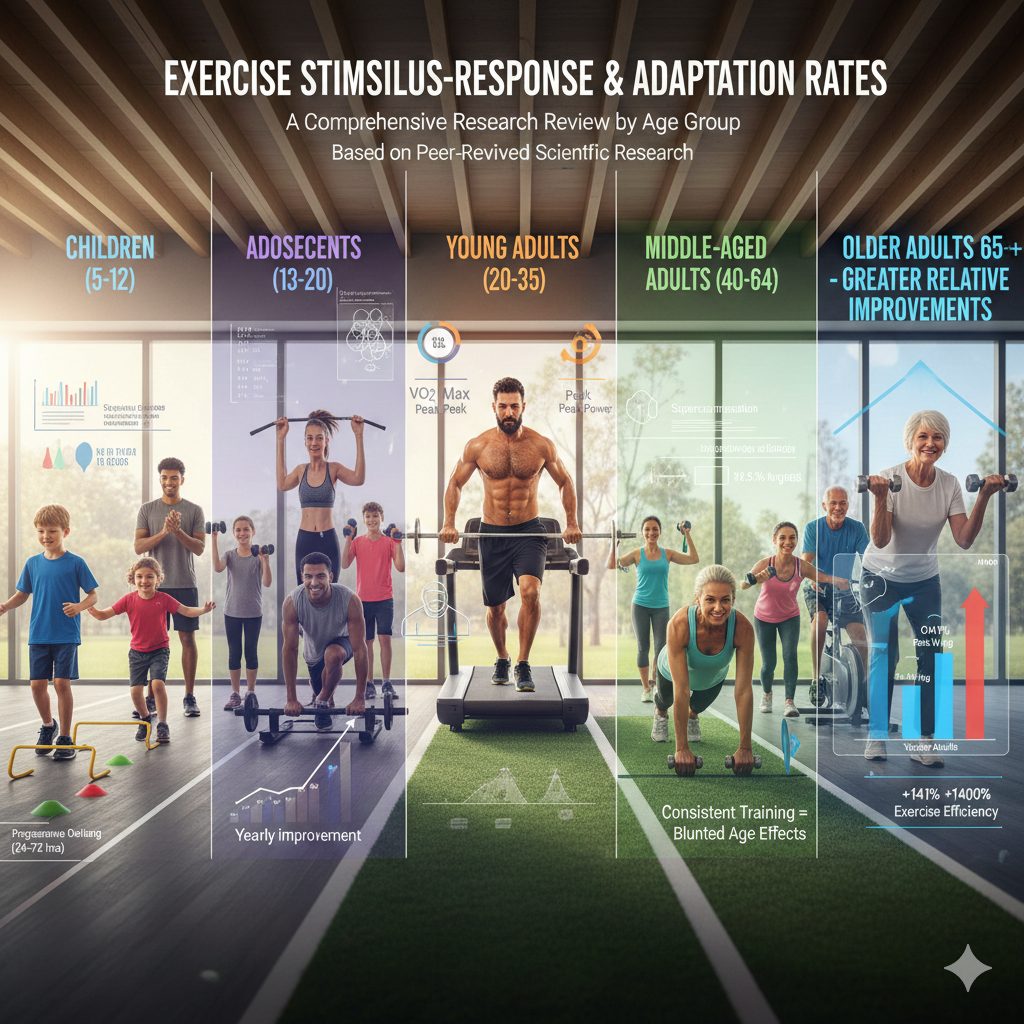
Exercise Stimulus-Response and Adaptation Rates: A Comprehensive Research Review by Age Group
This document provides a comprehensive overview of how the human body responds and adapts to exercise stimuli across different age ranges. The information is based on peer-reviewed scientific research published in leading sports science, physiology, and medical journals. Understanding these principles is essential for optimizing training programs and achieving maximal performance improvements at any age.
1. The Stimulus-Response Mechanism in Exercise
1.1 Core Principles
The stimulus-response principle is fundamental to adaptation. When exercise disrupts the body's equilibrium (homeostasis), a response is triggered to meet the increased demands.
The stimulus-fatigue-recovery-adaptation theory posits that training stimuli produce responses influenced by the magnitude of stress. Greater workload leads to more fatigue and requires longer recovery before complete adaptation can occur.
1.2 The Four Stages of Adaptation
Stage Description Key Characteristics Alarm Phase Initial fatigue and decreased performance Muscle soreness, energy depletion, temporary performance decline Resistance Phase Body begins adapting to stress Recovery occurs, systems strengthen, adaptation takes place Supercompensation Performance exceeds baseline Enhanced capacity, improved efficiency, peak adaptation window Exhaustion Phase Prolonged stress without recovery Overtraining risk, performance decline, increased injury risk
1.3 Key Training Principles
Progressive Overload: Gradually increasing the stress (weight, reps, intensity) placed on the musculoskeletal system. Recommended increases are 10% or less each week to minimize injury risk.
Periodization: The planned manipulation of training variables (load, sets, repetitions) to maximize adaptations and prevent overtraining. Research shows periodized programs produce superior strength and performance.
Training Specificity (SAID Principle): The body adapts specifically to the demands placed upon it. Adaptations occur primarily in recruited muscle fibers.
2. Adaptation Rates by Age Range
The capacity for adaptation varies significantly across the lifespan, revealing key differences in training focus and expected outcomes.
2.1 Children (Ages 5-12)
Adaptation Rate: 13–30% strength improvements with appropriate stimulus.
Key Characteristics: Strength gains occur primarily through neural adaptations rather than muscle hypertrophy. There are rapid improvements in coordination and motor control, with minimal muscle size increases.
2.2 Adolescents (Ages 13-20)
Adaptation Rate: Shows significant yearly improvement (e.g., girls peak at 12–13 years with 21% yearly improvement).
Key Characteristics: Youth show increased strength gains compared to adults undergoing initial training. Hormonal changes during puberty lead to marked improvements in strength. VO$_{2}$ max peaks between ages 17–21.
2.3 Young Adults (Ages 20-35)
Adaptation Rate: Period of peak physical performance capacity.
VO$_{2}$ peak (HIIT): 7.9%
Peak Power (Moderate Continuous): 21.9%
Key Characteristics: Early strength gains result primarily from neural adaptations; muscle mass increases drive later strength changes.
2.4 Middle-Aged Adults (Ages 40-64)
Adaptation Rate: Well-trained middle-aged adults show no statistical differences in performance outcomes or recovery rates compared to younger trained adults. Muscle fiber adaptations (Type I and IIa) improve 10–12% with extensive training.
Key Characteristics: Consistent long-term training can blunt age-related effects. Maintained capacity for strength and aerobic improvements is high.
2.5 Older Adults (Ages 65+) - Critical Findings
Measure Older Adults (65-79) Younger Adults (20-35) Relative Advantage Peak W/kg Increase +29% +12% Older +141% Exercise Efficiency +30% +2% Older +1400%
CRITICAL FINDING: Older adults show GREATER relative improvements (e.g., in exercise efficiency and power/weight ratio) than younger adults.
Key Characteristics: Training reverses age-related decreases in exercise efficiency. Preserved capacity to improve muscle strength (Type I and IIa fibers improve 10–12%). Consistency and functional movements are key focus areas.
3. Practical Applications and Recommendations
3.1 Training Frequency and Recovery
Age Group Recommended Sessions/Week Key Focus Children 2–3 Maintain strength gains Adolescents 3–4 Technique Young Adults 3–6 Depending on training goals Middle-Aged 3–5 Increased recovery attention Older Adults 2–3 Consistency over intensity
3.2 Progressive Overload Guidelines
Increase training volume by 2.5–5% per week (ACSM recommendation).
Maximum 10% increase per week to minimize injury risk.
Incorporate deload weeks every 3–6 weeks for optimal adaptation.
3.3 Supercompensation Timing
The optimal training window, when supercompensation peaks, is typically 24–72 hours post-training. Performance increase, lower resting heart rate, and increased energy are signs of supercompensation.
3.4 Age-Specific Considerations
Age Group Primary Adaptation Key Focus Areas Children (5-12) Neural/Motor learning Technique, coordination, movement patterns Adolescents (13-20) Neural + Hypertrophy Progressive loading, sport-specific skills Young Adults (20-35) Hypertrophy + Strength Peak performance, periodization Older Adults (65+) Efficiency + Function Consistency, functional movements, balance
4. Key Takeaways
Adaptation capacity does NOT decline linearly with age; older adults can show GREATER relative improvements.
Training stimulus, recovery, and progression must be properly balanced for optimal adaptation at any age.
Children adapt primarily through neural mechanisms.
Older adults show remarkable improvements in exercise efficiency that exceed younger populations.
Periodization produces superior results across all age groups.
Note: This document is based on peer-reviewed scientific research. Always consult with qualified healthcare and fitness professionals before beginning any exercise program.