FLOW TRAINING EXERCISE – QUICK REFERENCE
Quick Overview
Total Duration: 30 min/session
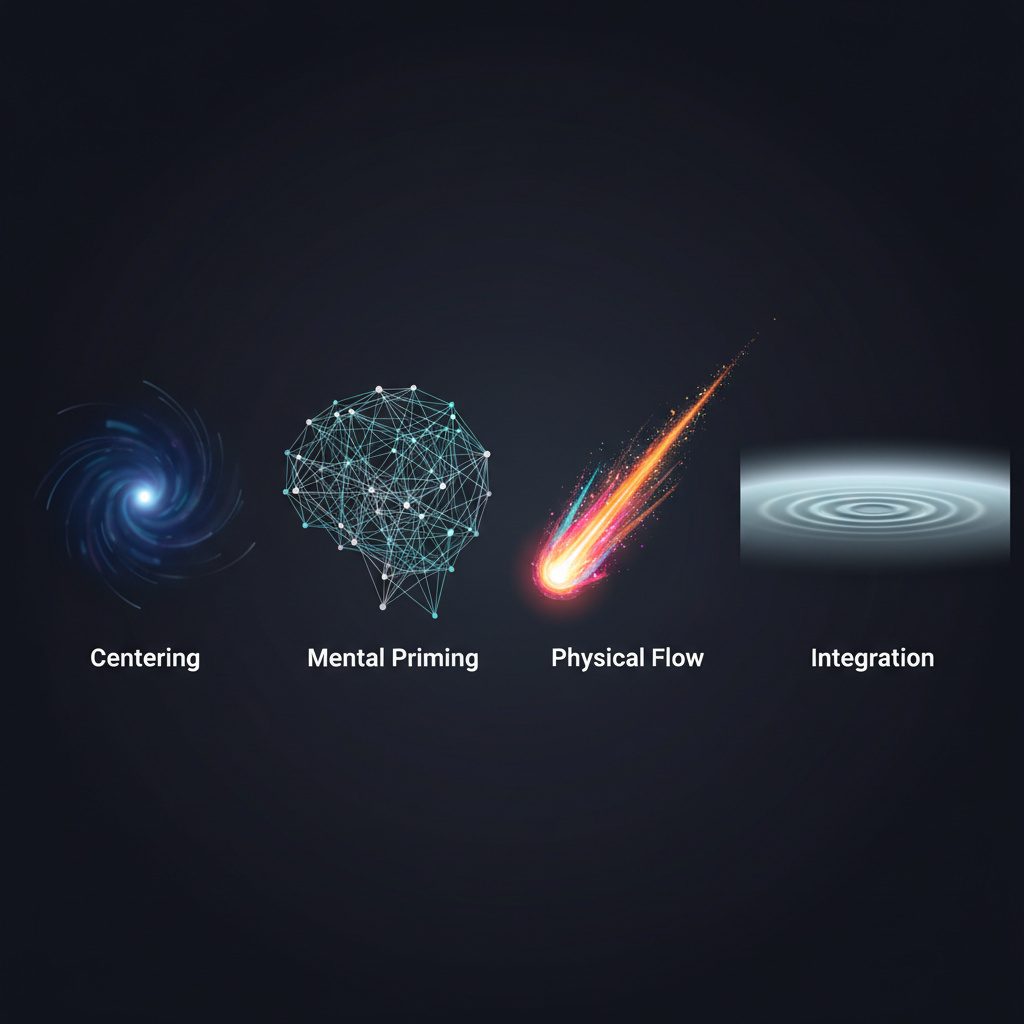
Phases & Duration:
Centering: 7 min (Box Breathing 4 min, Body Scan 3 min)
Mental Priming: 8 min (Mental Rehearsal 5 min, Flow Anchoring 3 min)
Physical Flow: 12 min (Progressive Skills 6 min, Flow Intervals 6 min)
Integration & Recovery: 3 min (Flow Reflection 2 min, Cooldown 1 min)
PHASE 1 – Arousal Regulation & Centering (7 min)
Goal: Activate parasympathetic nervous system, optimize arousal, present-moment awareness
Exercise 1.1 – Box Breathing (4 min, 6-8 cycles)
Purpose: Reduce cortisol, increase HRV, establish focus
Setup: Seated/straight spine, hand on chest/abdomen, eyes closed/soft gaze
Protocol:
Inhale 4 counts (diaphragmatic)
Hold full 4 counts (relaxed)
Exhale 4 counts (fully, no strain)
Hold empty 4 counts (effortless)
Repeat 6-8 cycles
Progression: Weeks 4–6 → 5-count; Weeks 7+ → 6-count
Common Mistakes: Chest breathing, tension holds, rushing, strain
Exercise 1.2 – Progressive Body Scan (3 min)
Purpose: Build interoceptive awareness, release tension
Step-by-Step: 20 sec each region:
Feet & Ankles
Calves & Shins
Thighs & Hips
Core & Lower Back
Chest & Upper Back
Shoulders, Arms & Hands
Neck & Jaw
Face & Head
Whole Body Integration
Principle: Observe sensations without manipulation
PHASE 2 – Mental Priming & Visualization (8 min)
Goal: Prime neural pathways, establish flow anchors, enhance pattern recognition
Exercise 2.1 – Multisensory Mental Rehearsal (5 min)
Purpose: Activate motor cortex, establish neural templates
PETTLEP Framework: Physical, Environment, Task, Timing, Learning, Emotion, Perspective
Steps:
Select Scenario (10 sec)
First-Person Perspective (10 sec)
Visual Details (45 sec)
Kinesthetic Sensations (60 sec) – Most important
Auditory Elements (30 sec)
Execute in Real-Time (90 sec)
Emotional State (throughout)
Exercise 2.2 – Flow State Anchoring (3 min)
Purpose: Conditioned response for faster flow entry
Setup: Centered, eyes closed
Steps:
Create Anchor (word/gesture/breath) 30 sec
Recall Peak Flow Memory 60 sec
Pair Anchor with State 90 sec – Repeat 3–4x
Critical Principle: Activate anchor only at peak flow memory
PHASE 3 – Physical Flow Drills (12 min)
Goal: Activate flow through challenge-skill balance & arousal
Exercise 3.1 – Progressive Challenge Skill Ladder (6 min)
Structure: 3 levels × 2 min each
Level 1: Baseline skill
Level 2: Challenge +1
Level 3: Challenge +2
Principle: Target success rate 85–90% (flow zone)
Sport Examples:
Basketball: Crossover → movement → speed + direction change
Soccer: Juggling → alternate feet → movement + weak foot
Tennis: Serve consistency → placement → speed & precision
Running: Tempo → pace → surge intervals
Swimming: Stroke count → reduce strokes → speed + efficiency
Exercise 3.2 – High-Intensity Flow Intervals (6 min, 3 rounds)
Structure: 90 sec work / 30 sec recovery
Intensity: 85–95% max effort, maintain technical form
Sport Examples:
Basketball: Full-court dribbling & finishes
Soccer: Box-to-box sprint + shoot
Tennis: Rally simulation
Running: Fartlek surges
Swimming: Pace pyramid
Cycling: 30-sec sprint/30-sec spin ×3
Recovery Protocol: 30 sec low-intensity movement, 4-count inhale / 6-count exhale
PHASE 4 – Integration & Recovery (3 min)
Exercise 4.1 – Flow State Reflection (2 min)
Purpose: Consolidate learning, track progress
Reflection Questions:
Flow Rating (0–10)
Flow Moments – specific skills/events
Challenge-Skill Balance – adjust tomorrow
Daily Adjustment – difficulty, breathing, visualization
Exercise 4.2 – Active Recovery & Cooldown (1 min)
Options:
Light movement (walk/jog/cycle)
Static stretching (3–4 muscle groups, 15 sec each)
Final breath work (3 deep belly breaths, 6-count inhale / 8-count exhale)
Progressive Weekly Adaptations (12 weeks)
Weeks Focus Adjustments 1–3 Foundation Box breathing 4-count, baseline physical drills, 80–85% effort 4–6 Integration Box breathing 5-count, visualization problem-solving, drills +15–20% complexity, 85–90% effort 7–9 Challenge Box breathing 6-count or alternate, high-pressure simulation, reactive drills, 90–95% effort 10–12 Mastery Simulated competition, flow anchor before each interval, combine multiple skills, transfer to performance
Troubleshooting
Can't calm down: Extend exhale, audible sigh, 5–6 min total
Mind wanders: Shorten visualization, guided scripts, emphasize kinesthetic cues
Drills too easy: Increase level, add time pressure, competition element
Drills overwhelming: Regress one level, break into components, reduce speed/intensity
Not feeling flow: Check challenge-skill balance, practice 5–6 days/week, manage stress, consult coach
Implementation Tips
Consistency over intensity
Same time/place daily (morning 6–9 AM ideal)
Eliminate distractions (phone off, no music during mental phases)
Trust the process – flow develops over weeks
Transfer to competition by Week 8–10
Celebrate small wins – track instances of effortless execution
Summary: 30 min/day, 12 weeks → structured flow training unlocks peak performance.