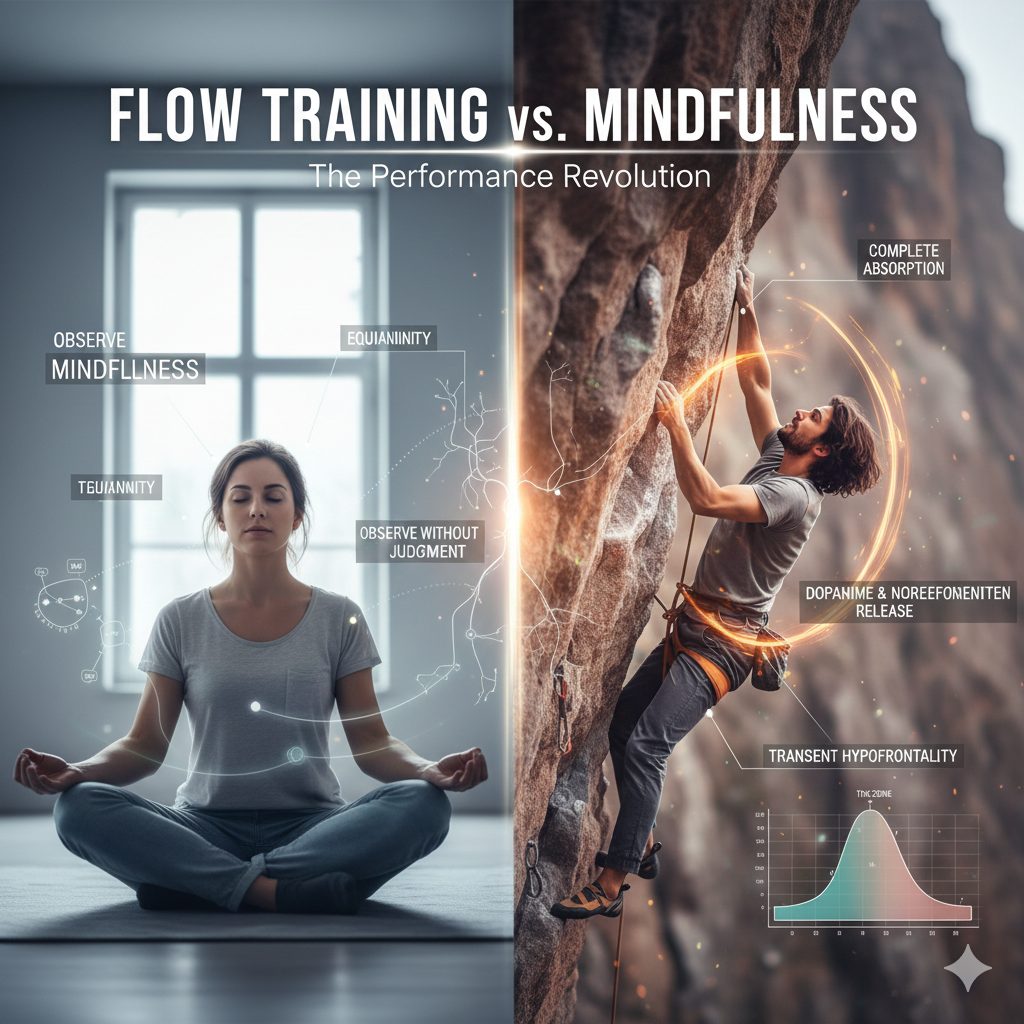
Flow Training vs. Mindfulness: The Performance Revolution
For decades, mindfulness has dominated the conversation about mental training and peak states. But a new approach is gaining traction among athletes, executives, and high performers: flow training. While both practices cultivate presence and awareness, flow training offers something fundamentally different—a targeted methodology for rewiring the brain toward specific performance outcomes.
The Mindfulness Foundation
Mindfulness teaches us to observe our experience without judgment. The goal is equanimity—developing a stable, non-reactive awareness that can weather any mental storm. It has proven effective for reducing stress, managing anxiety, and improving overall well-being.
Neurological Outcomes of Mindfulness:
Increased gray matter density in the prefrontal cortex (better emotional regulation).
Reduced amygdala activation (reduced reactivity to stress).
Mindfulness makes you a more balanced observer of your own experience.
The Flow Difference: Targeted Absorption
Flow training takes a different approach entirely. Rather than cultivating observation, it targets complete absorption. Instead of watching your experience, you disappear into it ("the zone"). The goal isn't acceptance—it's to engineer the conditions where peak performance becomes inevitable.
Flow states occur when challenge perfectly matches skill level, creating "the optimal experience" where time distorts, self-consciousness vanishes, and performance soars.
The distinction: Mindfulness rewires the brain for general resilience; flow training rewires it for specific performance outcomes.
Neuroplasticity with a Target
When you repeatedly enter flow states around a particular skill, several neurological changes occur that accelerate mastery:
1. Transient Hypofrontality Becomes Accessible
The prefrontal cortex (your inner critic/self-doubt) temporarily downregulates. This allows implicit knowledge to take over, making high-level performance feel effortless. Your brain learns to trigger this state more readily in high-stakes contexts.
2. Neural Pathway Optimization Accelerates
Flow states are associated with a neurochemical cocktail of dopamine, norepinephrine, and endorphins. This cocktail doesn't just feel good; it actively consolidates learning, encoding skills more deeply with each flow session.
3. Stress Response Recalibration
Unlike mindfulness, which teaches acceptance of difficulty, flow training teaches your nervous system that challenge is the gateway to peak experience. Your brain begins to associate high-stakes situations with optimal performance rather than threat.
The Neurochemical Advantage
The neurochemistry of flow is optimized for peak performance and deep learning:
Dopamine: Sharpened focus and pattern recognition.
Norepinephrine: Increased arousal and emotional intensity.
Endorphins: Blocks pain, creates pleasure.
Anandamide: Enhances lateral thinking and creative connections.
This potent cocktail creates optimal conditions for neuroplastic change. Skills learned in flow are encoded more deeply and retrieved more readily, effectively "highlighting" these experiences as critically important.
Building the Flow Architecture (Practical Implementation)
Flow training involves restructuring your work, practice, and environment around specific triggers, which differs markedly from a twenty-minute daily meditation:
Challenge-Skill Balance: Constantly calibrating tasks to remain at your growth edge (avoiding boredom or anxiety).
Clear Goals and Immediate Feedback: Eliminating ambiguity, which is flow's enemy.
Deep Embodiment: Developing flow while doing the thing you want to master (e.g., a rock climber through climbing, a writer through writing).
Environmental Design: Eliminating distractions and creating rituals that signal flow readiness.
The Complementary Path
Mindfulness and flow training are not mutually exclusive. Many elite performers use mindfulness as a foundation for flow training because it:
Develops the meta-awareness to recognize when you are entering or exiting flow.
Provides the emotional regulation needed to handle the intensity of high-stakes flow states.
Builds the baseline calm that makes deep focus possible.
But for those who want to rewire their brain for specific performance outcomes, flow training provides a more direct, targeted methodology. The question isn't which is better—it's what you're optimizing for.
Peak performance isn't about watching yourself perform—it's about disappearing into the performance itself. That's the revolution flow training brings.