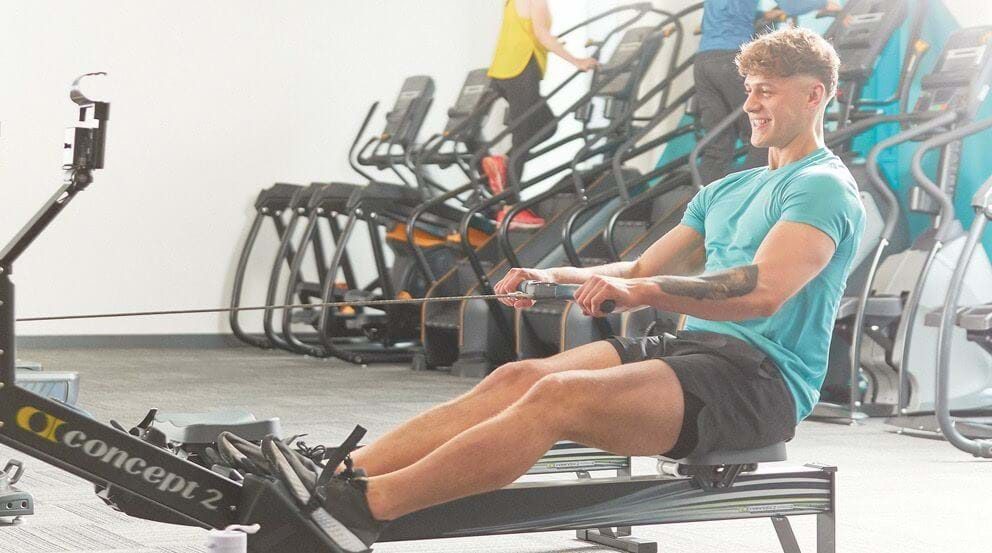
Functional Fitness Program
Fall Racing Season
Balance • Coordination • Kinetic Chain Integration
Movement Quality for Peak Performance
Created: October 22, 2025
Program Philosophy
This functional fitness program emphasizes movement quality, coordination, and integrated kinetic chain function rather than isolated muscle strength. During the fall racing season, improving how muscles work together—from feet through core to hands—enhances force transfer efficiency, reduces energy leaks, and promotes athletic movement patterns that directly improve rowing performance.
Unlike traditional strength training that isolates muscle groups, functional fitness develops the nervous system's ability to coordinate complex movement sequences. This approach proves particularly valuable during racing season when technical refinement and movement efficiency become paramount. By training balance, proprioception, and multi-planar movement, rowers develop robust athleticism that supports both performance and injury resilience.
Core Training Principles
Movement Over Muscles: Prioritize movement patterns and coordination over isolated muscle development.
Stability Before Mobility: Establish stable base positions before adding mobility or load challenges.
Unilateral Emphasis: Single-leg and single-arm exercises expose and correct asymmetries.
Rotational Integration: Include rotation patterns often missing from rowing's sagittal plane dominance.
Proprioceptive Challenge: Unstable surfaces and balance requirements enhance body awareness.
Kinetic Chain Sequencing: Train force generation and transfer from ground through full body.
Quality Over Load: Perfect movement execution takes priority over resistance magnitude.
Recovery Friendly: Lower systemic fatigue compared to heavy strength training.
Weekly Training Structure
Monday
Rowing Focus: Recovery/Technique
Functional Session: Session A – Lower Body Integration
Duration: 40 min
Tuesday
Rowing Focus: Steady State
Functional Session: —
Duration: —
Wednesday
Rowing Focus: High Intensity
Functional Session: Session B – Rotational & Core
Duration: 35 min
Thursday
Rowing Focus: Steady State
Functional Session: —
Duration: —
Friday
Rowing Focus: Race Prep/Light
Functional Session: Session C – Balance & Coordination
Duration: 30 min
Saturday
Rowing Focus: Competition/HIT
Functional Session: —
Duration: —
Sunday
Rowing Focus: Competition/Long
Functional Session: —
Duration: —
Session A: Lower Body Kinetic Chain Integration
Session Structure (40 min)
Warm-Up: Movement Prep – 8 min, joint mobility & activation
Circuit 1: Kinetic Chain Development – 15 min, 3 rounds
Circuit 2: Balance & Stability – 12 min, 3 rounds
Cool-Down: Movement Flow – 5 min, mobility & integration
Circuit 1: Kinetic Chain Development (3 rounds)
Single-Leg Deadlift – 8-10/leg, hip hinge & balance, rest 30s
Lateral Lunge with Reach – 8/side, frontal plane mobility, rest 30s
Kettlebell Swing – 12-15 reps, hip drive & kinetic chain, rest 45s
Bird Dog (Alternating) – 10/side, core stability & coordination, rest 30s
Circuit 2: Balance & Stability (3 rounds)
Single-Leg Squat to Box – 6-8/leg, eccentric control & balance, rest 30s
Split Stance RDL – 8-10/leg, posterior chain & stability, rest 30s
Skater Hops – 10/side, lateral power & landing control, rest 45s
Plank with Leg Lift – 8/leg, anti-extension & stability, rest 30s
Session B: Rotational Power & Core Integration
Session Structure (35 min)
Warm-Up: Rotational Prep – 7 min, thoracic mobility & hip rotation
Circuit 1: Rotational Power – 12 min, 3 rounds
Circuit 2: Core Integration – 12 min, 3 rounds
Cool-Down: Mobility Flow – 4 min, thoracic & hip mobility
Circuit 1: Rotational Power (3 rounds)
Medicine Ball Rotational Throw – 8/side, explosive rotation, rest 45s
Half-Kneeling Chop – 10/side, diagonal pattern & core control, rest 30s
Landmine Rotation – 10/side, transverse plane power, rest 30s
Russian Twist (weighted) – 20 total reps, rotational endurance, rest 45s
Circuit 2: Core Integration (3 rounds)
Pallof Press (standing) – 10/side, anti-rotation strength, rest 30s
Dead Bug (opposite limbs) – 10/side, coordination & anti-extension, rest 30s
Side Plank with Rotation – 8/side, lateral stability & mobility, rest 30s
Bear Crawl – 20 yards, full body integration, rest 45s
Session C: Balance, Coordination & Movement Quality
Session Structure (30 min)
Warm-Up: Gentle Movement – 5 min, joint articulation & breathing
Circuit 1: Balance Challenges – 10 min, 2-3 rounds
Circuit 2: Coordination Patterns – 10 min, 2-3 rounds
Cool-Down: Breathwork & Mobility – 5 min, relaxation & restoration
Circuit 1: Balance Challenges (2-3 rounds)
Single-Leg Balance (eyes closed) – 30 sec/leg, proprioception
BOSU Ball Squats – 10 reps, dynamic stability
Single-Leg Reach (multi-directional) – 6/direction/leg, hip stability
Wobble Board Standing – 45 sec, ankle stability & micro-adjustments
Circuit 2: Coordination Patterns (2-3 rounds)
Cross-Crawl Pattern – 20 total, contralateral coordination
Single-Arm Kettlebell Flow – 30 sec/arm, timing & force modulation
Jump Rope (varied patterns) – 45 sec, foot-eye coordination & timing
Turkish Get-Up – 2/side, full-body coordination & transitions
Detailed Exercise Descriptions
Comprehensive instructions with focus on functional movement patterns, kinetic chain sequencing, and coordination.
1. Single-Leg Deadlift (SL RDL)
Purpose: Unilateral hip hinge, posterior chain, dynamic balance.
Execution: Hinge at hips, extend free leg behind, drive through heel.
Common Errors & Fixes: Hips rotate → Keep square; Knee bends excessively → Maintain angle.
Progression: Bodyweight → Light weight → Moderate weight → Unstable surface.
2. Lateral Lunge with Reach
Purpose: Frontal plane strength, hip stability, rotation.
Execution: Step laterally, bend knee, reach arms toward stepping foot.
Errors: Knee caves → Push outward; Torso leans → Chest up; Weight shifts → Press through heel.
3. Kettlebell Swing
Purpose: Explosive hip extension, kinetic chain integration.
Execution: Hike → Hip drive → Float and return.
Errors: Squatting → Emphasize hinge; Pulling with arms → Power from hips.
4. Single-Leg Squat to Box (Pistol Progression)
Purpose: Unilateral lower body, eccentric control, balance.
Execution: Slow descent → Controlled ascent, pause at top.
Progression: High box → Mid box → Low box → Full pistol → Weighted pistol.
5. Medicine Ball Rotational Throw
Purpose: Explosive rotational power, triple extension.
Execution: Load → Rotate → Release → Follow-through.
Errors: Upper body rotates first → Hip leads; Narrow stance → Wider base.
6. Turkish Get-Up (TGU)
Purpose: Full-body coordination, transitions, shoulder stability.
Execution: Ground → Elbow → Tall Sit → Bridge → Sweep leg → Half-Kneel → Stand.
Errors: Arm bends → Lock; Eyes leave weight → Maintain focus; Rushing → Slow transitions.
Movement Preparation and Recovery Protocols
Universal Movement Preparation (8-10 min)
Breathing & Centering (2 min) – Diaphragmatic breathing, focus on exhale.
Joint Articulation (3 min) – Ankle, knee, hip, spine, shoulder, neck circles.
Dynamic Movement Patterns (3 min) – Cat-Cow, World's Greatest Stretch, Squat to Stand, Walking Spiderman, Leg Cradles.
Activation Drills (2 min) – Glute bridges, Bird Dog, Plank, Bear Crawl.
Post-Session Flow (5-10 min)
Breathing Reset (2 min) – Diaphragmatic and box breathing.
Dynamic Mobility Flow (5 min) – Child’s Pose to Cobra, 90/90 Hip Rotations, Thread the Needle, Downward Dog to Runner’s Lunge, Seated Spinal Twist.
Static Holds (3 min) – Pigeon Pose, Supine Figure-4, Prone Quad, Standing Hip Flexor.
Program Implementation Guidelines
Movement Quality Standards
End sets if technique deteriorates.
Address asymmetries in unilateral work.
Maintain neutral spine in core exercises.
Integration with Rowing
Functional sessions are less fatiguing than heavy lifting.
Best performed after easy rowing or rest days.
Avoid before high-intensity rowing or races.
Progressive Development Framework
Phase 1: Pattern Establishment (Weeks 1-2)
Phase 2: Stability Challenge (Weeks 3-4)
Phase 3: Coordination Complexity (Weeks 5-6)
Phase 4: Load Integration (Weeks 7-8)Final Notes
Prioritize quality over quantity.
Respect individual differences.
Embrace gradual progress and enjoy the journey.
Functional fitness complements but does not replace sport-specific rowing or strength training.
This program develops movement competencies, balance, coordination, and kinetic chain integration, producing rowers capable of peak performance, injury resilience, and efficient athletic movement.