Introduction to the 12-Week Flow Training Program for Skill Acquisition
What Is Flow State?
Flow, often described as being "in the zone," is a mental state of complete absorption where a person becomes fully immersed in an activity, experiencing energized focus, full involvement, and enjoyment. First identified by Mihály Csíkszentmihályi in 1975, flow represents the optimal psychological state where action and consciousness merge, and time seems to transform.
The Science Behind Flow and Skill Acquisition
Flow states dramatically enhance learning and performance:
Skill Acquisition: 490% increase observed in flow states (Advanced Brain Monitoring & DARPA).
Productivity: Up to 500% improvement.
Creativity: Up to 600% increase.
Skill Improvement: 230% faster development.
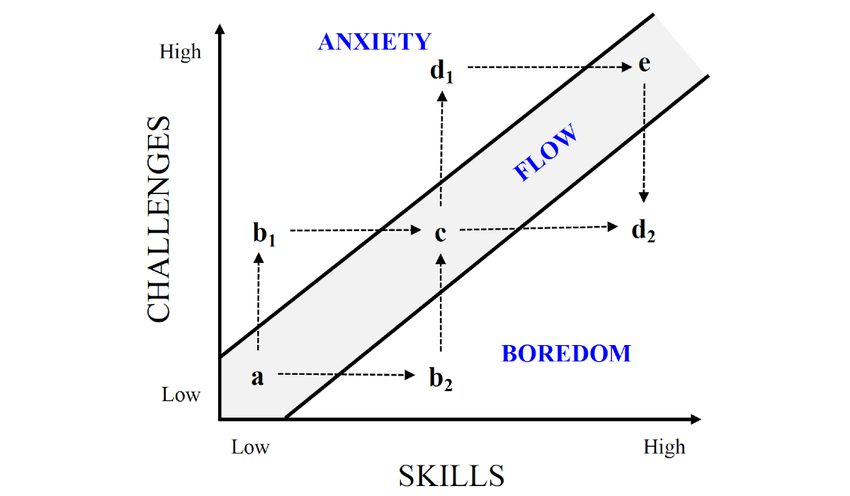
Flow occurs when challenges and skills are high and in equilibrium, maintaining engagement at the edge of capability.
Core Principles of Flow
Key preconditions for flow:
Challenge-Skill Balance: Tasks match skill level.
Clear Goals: Objectives are specific and meaningful.
Immediate Feedback: You know your progress instantly.
Present-Moment Focus: Complete concentration on the task.
The Nine Characteristics of Flow
Challenge-Skill Balance – Optimal engagement without boredom or anxiety.
Action-Awareness Merging – Actions feel automatic and effortless.
Clear Goals – Full understanding of success criteria.
Unambiguous Feedback – Immediate information to adjust performance.
Concentration on Task – Distractions fade; attention is fully focused.
Sense of Control – Confidence in your ability to meet challenges.
Loss of Self-Consciousness – Ego and self-doubt disappear.
Transformation of Time – Distorted perception of time.
Autotelic Experience – Activity is intrinsically rewarding.
Why a 12-Week Program?
A 12-week timeframe allows for:
Formation of new neural pathways
Development of consistent practice habits
Measurable progress in skill acquisition
Program progression:
Weeks 1-3: Foundation building and flow principles
Weeks 4-6: Developing awareness and recognizing flow triggers
Weeks 7-9: Actively inducing flow states during practice
Weeks 10-12: Mastery and integration into daily practice
Flow-Skill Acquisition Connection
Structured tasks aligned with skill levels accelerate learning.
Immediate feedback enhances mastery.
Flow improves both acquisition of new skills and refinement of existing skills.
Positive effects include confidence, ease of execution, and automaticity.
Program Structure and Approach
The 12-week program combines three essential elements:
Deliberate Practice with Flow Principles – Balancing skill and challenge dynamically.
Mindfulness and Awareness Training – Meditation and attention exercises sharpen focus.
Progressive Challenge Scaling – Increasing task difficulty to maintain flow.
Expected Outcomes
Participants completing the program can expect:
Enhanced Learning Speed – Rapid skill acquisition
Increased Performance Quality – Consistent execution at higher levels
Greater Intrinsic Motivation – Engagement without external rewards
Reduced Performance Anxiety – Accessing optimal states under pressure
Improved Focus and Concentration – Deep work readiness
Specific Benefits for Sports Performance
Enhanced Athletic Execution: Flow supports confidence and automaticity.
Positive Performance Cycle: Flow experiences build confidence and skill development.
Peak Performance Access: Prefrontal cortex deactivation enables effortless execution.
Sustained Multi-Day Performance: Flow benefits extend for up to 3 days post-experience.
Transformative Benefits for Youth Development
Optimizes skill acquisition during critical adolescent development.
Enhances visual attention, inhibitory control, reaction times, and accuracy.
Promotes mental health, self-confidence, persistence, and resilience.
Builds foundational life competencies: goal setting, feedback response, intrinsic motivation.
Age-Appropriate Applications:
Ages 10-14: Fundamental flow experiences with structure and feedback.
Ages 15-18: Autonomous flow creation, goal mastery, multi-domain application.
Ages 18-25: Advanced flow management for career preparation and life transitions.
Getting Started
The journey begins with understanding how to create conditions for flow:
Balance perceived challenge and skill
Set clear, achievable goals
Receive consistent feedback
Maintain intense focus
This framework is applicable for athletes, youth, educators, and coaches, providing practical tools for exponential skill growth over 12 weeks.
References
Csíkszentmihályi, M. (1975). Beyond Boredom and Anxiety. Jossey-Bass.
Csíkszentmihályi, M. (1990). Flow: The Psychology of Optimal Experience. Harper & Row.
Flow Research Collective. (n.d.). Retrieved from www.flowresearchcollective.com
Nakamura, J., & Csíkszentmihályi, M. (2002). Handbook of Positive Psychology, 89-105.
Advanced Brain Monitoring & DARPA research on skill acquisition in flow states
Jackson, S. A., & Csíkszentmihályi, M. (1999). Flow in Sports. Human Kinetics.
Amabile, T. (Harvard research on post-flow creativity and productivity)
Schüler, J., & Brunner, S. (2009). Psychology of Sport and Exercise, 10, 168–174.